The best minds of medicine today have no solution for pancreatic cancer. From your physician’s perspective, pancreatic cancer is an incurable disease. Prognosis is terminal. Accordingly, all treatments are only intended to extend life or provide palliative care. Surgery, radiation and chemotherapy have minimal impact and may provide only minimal improvement to survival. Alternatively, research supports that treatments may actually accelerate the progression of the disease. Yet, since the cancer is terminal with no cure, physicians, oncologists, are provided the latitude to experiment. Sequential chemotherapy drugs are offered to “try” if the previous drug did not work (created a resistant,
more aggressive cancer). Since the patient is considered to be terminal, long-term, debilitating side effects of treatments are not considered. Usually diagnosed in late-stage disease phase, the cancer is typically already metastasized to other organs.
Nutritional agents have demonstrated “spontaneous cures” for pancreatic cancer. New formulation technologies such as nanoparticle encapsulation have increased the bioavailability of these agents by factors of 50x to over 90x. By targeting multiple disease pathways at the cell level, progression of pancreatic cancer can be stopped, tumors reduced. This can be achieved over a short period of time, typically 90 days, without side effects, without the cancer becoming resistant to treatment it is with chemotherapy drugs.
“Pancreatic cancer is known to be one of
the most lethal cancers. The majority of
median survival does not exceed 6
months in metastatic disease and 10
months in locally advanced disease.
Furthermore, the 5-year survival rate
remains poor even in patients with early
stage disease who are surgical
candidates. The detrimental outcome is
related to the high potency of developing
metastasis which can be detected at
diagnosis, when the disease progresses
or relapses after surgery. Although the
liver is the most common site of
pancreatic cancer metastases, the cancer
can escape the liver in some cases and
metastasize to the lung or other distant
organs.”
Pulmonary metastases in pancreatic cancer, is there a
survival influence?
Ayham Deeb, Sulsal-Ul Haque, and Olugbenga Olowokure
Journal of Gastrointestinal Oncology. 2015 Jun
\metastasis survival pancreatic 2015.pdf
“Gemcitabine treatment, the current gold standard therapeutic agent (chemotherapy) of pancreatic cancer also has been shown to induce cachexia in an experimental model of pancreatic cancer [11], similar to other anti-cancer agents such as taxanes [12]. Considering all these facts, there is an instant need of alternative therapeutic agents that possess anti-cancerous as well as anticachectic properties.”
“Our results demonstrate that (natural agent) silibinin inhibits pancreatic cancer cell growth in a dose-dependent manner and reduces glycolytic activity of cancer cells. Our LC-MS/MS based metabolomics data demonstrates that silibinin treatment induces global metabolic reprogramming in pancreatic cancer cells.”
“We observed a significant reduction in tumor growth rate and tumor volume upon necropsy in silibinin-treated tumor-bearing mice in comparison to the control group (Figure 5A–5C). We also observed a significant difference between body weight of the control group and silibinin-treated mice (Figure 5D), with significantly reduced weight loss in the silibinin-treated tumor-bearing mice.
Furthermore, we observed reduced tumor cell proliferation in the silibinin-treated group in comparison to the control group, as evident by reduced Ki67-positive cells in the silibinin-treated tumor sections (Figure 5E). We also observed reduced tumoral c-MYC, GLUT1, and pSTAT3 expression in silibinin-treated mice in comparison to the controls (Figure 5E), which corroborates our results from cell culture-based studies.”
Silibinin-mediated metabolic reprogramming attenuates
pancreatic cancer-induced cachexia and tumor growth
Surendra K. Shukla, et al. Oncotarget, Vol 6, No. 38, 2015
“As a result, satisfactory therapeutic effects were obtained, such as improvements in biological functions and spontaneous cure power.”
“CT images showed marked reductions of the pancreatic cancer and liver
metastases (figure 1b).”
“… three months after treatment initiation, the tumor markers rapidly decreased (CEA 93.6 ng/ml from 441 ng/ml, CAI9-9 6,300 U/ml from 61,000 U/ml)…”
“The diameter of the pancreatic cancer was almost unmeasurable, and the liver metastases reduced in the same way… Early cancer on the anterior wall of the angular lesser curvature stomach completely disappeared (figure 3b, arrow). A biopsy revealed no malignant tumor
cells.”
“The patient had the decreased sugar metabolism peculiar to pancreatic cancer, but the combination therapy allowed easy control of the blood sugar, and a good nutritional state was maintained.”
A Case Where an Immunomodulatory Food was Effective in Conservation
Therapy for Progressive Terminal Pancreatic Cancer
K Kakatani, Hanzomon Gastrointestinal Clinic
Clinical Pharmacology and Therapy, Vol 14, No. 3, May 2004
“Patients received 8 g curcumin by mouth daily until disease progression, with restaging every 2 months. Serum cytokine levels for interleukin
(IL)-6, IL-8, IL-10, and IL-1 receptor antagonists and peripheral blood mononuclear cell expression of NF-nB and cyclooxygenase-2 were monitored.”
“Patients took oral curcumin daily for 8 weeks. The starting dose was 8 g/d. The patients could not receive any concomitant chemotherapy or
radiotherapy, although they could receive supportive care. Patients who had stable disease or better after 8 weeks received continued therapy with curcumin at the same dose and schedule.”
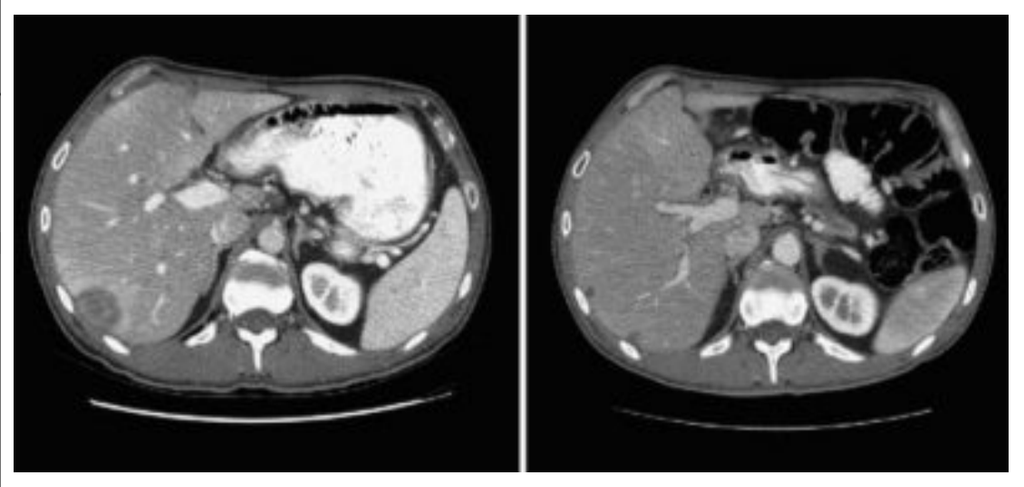
“Fig. 2. Computed tomography scan of the abdomen showing hepatic lesions in patient [8]. The computed tomography scans on the left were done pre-therapy; the one on the right were done at 2 mo after starting curcumin. There was an overall 73% decrease in the size of liver
lesions by Response Evaluation Criteria in Solid Tumors.”
“There was no dose-limiting toxicity; dosing was limited by the number of pills that patients could or would swallow daily.”
Phase II Trial of Curcumin in Patients with Advanced Pancreatic Cancer
Navneet Dhillon, et al., American Association for Cancer Research, 2008