Jeff is diagnosed May 2014, advanced metastatic prostate cancer
PSA blood test reveals 2,411 ng/ml (normal average this age group, 4.0 ng/ml) Osseous metastatic prostate cancer, “diffuse, intense and inhomogeneous bone uptake.” Multiple soft tissue lesions, characterized to be metastatic prostate cancer tumors in lungs, liver and adrenal glands. Patient begins chemotherapy, ADT and zolodronic acid therapies in Fall of 2014 Jeff begins enhanced nutritional regimen, July 2015
In July of 2015, we were asked to contact Jeff by his brother, who,
at the time was working with me as a contractor to renovate a
home. After brief introductions, Jeff reviewed his history and
current status. Jeff is 61 years young. In May of 2014, Jeff was
diagnosed with advanced metastatic prostate cancer. For a man of
his age, a PSA (prostate specific antigen blood test) should be in
the range of 1.0 – 5.0 ng/ml. Jeff’s PSA (prostate specific antigen)
was initially diagnosed as 2,357.0 ng/ml (peak of 2,411 ng/ml).
Subsequent tests, comprised of CT, CT-PET and nuclear medicine
scans revealed that Jeff had widespread metastatic prostate cancer
that involved the majority of his skeleton. Radiology reports also
described several soft-tissue lesions located in his lungs, adrenal glands, and liver.
Jeff had undergone the typical regiment of therapies, and suffered the side effects from those therapies. Jeff also experimented with nutritional therapies on his own.
Jeff had been treated with chemotherapy beginning in September of
2014. The chemotherapy consisted of six sessions of Taxotere (Docetaxel) infusions over a period of 18 weeks. This chemotherapy
drug is so toxic, that the drug dexamethasone, a steroid, was also required to control the side effects of the chemotherapy. Unfortunately, Jeff had previously suffered an adverse reaction to the drug. In 1980, Jeff was hospitalized for severe headaches and treated with dexamethasone. Jeff was required to continue taking this drug to gradually reduce his dependence on the drug. As a consequence, he developed avascular necrosis in his shoulder to such extent that, in 1986, his doctor had recommended artificial shoulder replacement. His necrosis had also caused painful symptoms in his knees and hips. Instead of replacing his joints, Jeff’s salvation was provided by a talented chiropractor, who through manipulation, relieved Jeff of his pain. To date, Jeff has not required, nor received a single artificial joint.
In addition to the chemotherapy for his newly diagnosed prostate cancer, Jeff also began treatments of androgen deprivation therapy
(ADT) and zolodronic acid, a bisphosphonate. All of the drugs were administered to treat the advance of his metastatic cancer, occurring primarily throughout his skeleton. Zolodronic acid therapy was administered to limit bone resorption caused by cancer. Jeff received these two therapies from Fall of 2014 through February of 2016, when Jeff told his oncologist that he had decided to stop the therapies due to side effects and concerns that his cancer would become resistant to the drugs. More later.
After discussing with Jeff his history and feelings about nutrition and cancer, we decided to begin a regimen comprised of enhanceddosing of a synergistic combination nutritional supplements. All of the supplements were commercial products available at retail stores and on the internet. The regimen was a challenge, as in addition to the quantity of capsules required to be taken daily, the cost of the supplements impacted his limited budget dramatically. Also, there is significant fear generated by a current marketing campaign comprised of negative articles published about nutritional supplements. Over time, we expected that Jeff would be pressured to discontinue the regimen. Jeff began the regimen in July
of 2015. The next session of diagnostic imaging was scheduled for
December 2015.
After some initial minor nausea and diarrhea, Jeff was taking the complete regimen within the first two weeks. Jeff agreed to obtain
and provide copies of his diagnostic imaging exams, his radiologist’s reports and copies of all blood tests.
At time of Jeff’s beginning the regimen, his PSA had been reduced
by the ADT therapy from a high of 2,411 ng/ml to a range that indicated a moderation in progression with a subsequent reduction of PSA. Zolodronic acid has been shown to reduce bone loss in cancer. These two therapies are common practice in advanced prostate cancer. Unfortunately, both of these drugs are known for serious side effects. By October, Jeff’s PSA had begun to drop to under 30 ng/ml. This was encouraging but could also have been coincidental.
From May 2014 through the last imaging session in February 2015,
radiologist’s reports described Jeff’s bone metastases as “inhomogeneous, with hot spots.” These are characteristics of advanced progressive metastatic disease and were consistent with his extremely high initial PSA. Additionally, advanced prostate cancer is known to metastasize to lungs, liver, brain and other organs. Radiologists had identified lesions in his lungs, liver and on his adrenal gland and estimated that these lesions were metastatic disease. His cancer was very aggressive and it was unclear whether his drug treatments were providing benefit. Even though this is the standard of care for most patients with advanced prostate cancer.
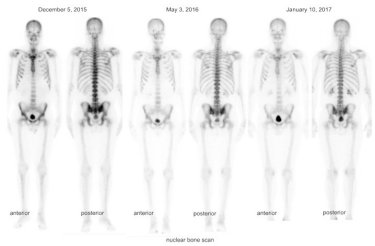
In December 2015, CT and nuclear medicine exams revealed that Jeff’s metastatic bone cancer had become “homogeneous, without any hot spots.” Regarding the numerous soft tissue lesions, “The liver, spleen, pancreas, adrenal glands and kidneys are within normal limits. No bowel abnormalities are identified. No acute abnormality or evidence of new metastatic disease in the chest, abdomen or pelvis.” Of course, we were cautiously optimistic but excited to see potential progress. Amazing progress. For example, on the CT images, it was apparent that the 1.9 cm liver lesion and other lesions had been significantly reduced to become barely detectable. The bone metastases were “homogeneous without hot spots” suggesting that the cancer had, in fact, stabilized and was
no longer progressing. Could this be true? Next imaging session was scheduled for May 2016.
Jeff is a unique individual. He has taken on this project and become fiercely dedicated to it. We did not expect Jeff to either tolerate the daily regimen this long, or afford the monthly expense, a significant impact to Jeff’s budget and lifestyle. Jeff’s blood tests confirmed that the supplements aside from PSA, did not negatively affect any of the standard blood panel indicators, including blood glucose levels, liver and kidney function. In fact, his blood results were consistently good, in normal ranges. Jeff was faithful to his regimen.
February 2016, Jeff stops both ADT and Zolodronic Acid therapies
In February, in a conversation with Jeff, we discovered that he had
been receiving ADT and zolodronic acid therapies for over 15 months. We informed Jeff regarding concerns about these drugs several recent published studies (examples below) revealed that these therapies over time created a cancer “resistant” to therapies, and created a “more aggressive” cancer. Resistance was “inevitable” and occurred within 12-24 months of beginning the therapies. Additionally, Jeff has suffered from jaw necrosis, a known side effect of zolodronic acid.
“Although advanced prostate cancer is generally sensitive to initial androgen deprivation therapy (ADT), responses are in most cases not durable and disease progression is inevitable.”
Sequential use of novel therapeutics in advanced prostate cancer following docetaxel chemotherapy
Therapeutic Advances in Urology, 2014
“Adverse effects of ADT include decreases in bone mineral density; metabolic changes such as weight gain, decreased muscle mass, and increased insulin resistance; decreased libido and sexual dysfunction;
hot flashes; gynecomastia; reduced testicle size; anemia; and fatigue. Several observational studies suggest an increased risk of diabetes and
cardiovascular events,
Adverse Effects of Androgen Deprivation Therapy and Strategies to Mitigate Them.
European Urology, 2014
“Thus, for the first time, we demonstrate that the p38- MAPK pathway can be activated under continuous acquisition of a more aggressive and invasive phenotype.”
Acquired resistance to zoledronic acid and the parallel acquisition of an aggressive phenotype are mediated by p38-MAP kinase activation in prostate cancer cells
Citation: Cell Death and Disease (2013) & 2013 Macmillan Publishers Limited
May 2016, dramatic improvement!
The imaging performed in May of 2016 brought surprise, amazement and even shock to Jeff, to us and to Jeff’s physicians. In the radiologist’s report, “No focal sites of metastatic disease identified. No overt osseous metastatic disease identified. Today’s study has more the appearance of a near normal bone scan rather than a Superscan (widespread bone metastases).”
May 2016: “Today’s study has more the appearance of a normal
bone scan…”
Jeff’s physicians were optimistic, but guarded. With many cancers
and treatment therapies physicians and health workers are not
surprised when cancers go into “remission” (though this was a
truly dramatic example!). The expectation is that the cancer will
return within a few months and it return will signal the “end
stages” of the disease.
By May of 2016, Jeff had completed 9 months of his nutritional
supplementation regimen. Of course, we were enthusiastic but
remained cautious. Even though, we were considering that Jeff may
survive this horrible, terminal disease – defeat the disease without
surgery, radiation or chemotherapy. ADT and zolodronic acid drugs
were discontinued in February 2016. We continued to monitor Jeff’s
PSA and it was now creeping up from a low of 11 ng/ml in
February to a level of 28.1 ng/ml in May. His next round of imaging
exams were scheduled for October 2016.
Is Jeff’s case a “fluke” or a prototype?
Nine months with virtually clear bone scans. Jeff’s scheduled diagnostic CT and nuclear medicine exams in October, 2016, revealed no significant indications of cancer. Then in January of 2017, more imaging, same result: no clear evidence of cancer! Jeff was still taking his original nutritional regimen, now for 18 months! The last session of diagnostic imaging has now revealed that Jeff has be virtually clear of cancer for 9 months
Oct 2016: “No focal abnormal activity to indicate active osseous
metastatic disease.”
The radiologist’s reports of January 10, 2017, sited no findings of
prostate cancer. Did not mention any soft tissue tumors, suspicious
areas, etc. A very short report. Report concluded,
Jan 2017: “No obvious sites of active osseous metastatic disease.”
Rising PSA after terminating ADT, new dilemma, or a
new understanding?
By terminating ADT shots in February, Jeff was free of risks of the
therapy with the additonal benefit of his testosterone levels
beginning to return to normal. Another direct result was that Jeff’s
PSA was also continuing to rise. In October of 2016, Jeff’s PSA had
risen to 81.2 ng/ml, up from 28.1 ng/ml in May. Now in January 2017, Jeff’s PSA has continued to rise to 194.5 ng/ml. For Jeff’s remaining cancer and prostate tissue, the effects of stopping the ADT therapy were showing their impact – his PSA was rising. We also noted that testosterone levels were continuing to increase. In October, Jeff’s testosterone level was 506. In January 2017, the level had increased to 584. This presents the indication that, even though ADT was terminated in February 2016, Jeff’s body was continuing to recover almost a year later!
So, what does a PSA of 194.5 mean to a patient that has a virtually
clear bone scan? Jeff’s oncologist recommended and scheduled an
appointment to confer with a radiation oncologist. By Jeff’s
oncologist’s standards, a very high PSA level of 194.5 ng/ml.
Yet, an appearance of a “near normal scan,” no evidence of metastatic cancer!
As of this writing, Jeff is meeting with the radiation oncologist this
week. We are interested to see how the doctor will attempt to justify this therapy. Going forward, we expect that Jeff will require a “maintenance” regimen of nutrition (also an effective preventative
regimen for anyone) to neutralize any residual cancer cells, rise of a potential disease environment or any re-awakening of dormant cancer cells (if any remain). Jeff has begun an additional regimen to rebuild his bone structure. It is unfortunate that, for patients with “terminal cancer,” the cumulative side effects of the disease and treatments are simply ignored, aside from palliative care (for pain and nausea). There no efforts to minimize bone loss or recover lost bone tissue. Jeff is minimally anemic This is probably due to the diminished volume of bone marrow.
So, how much prostate cancer tissue remains in Jeff’s body? Is it possible that a significant portion of this tissue is non-cancerous prostate tissue?
One possible explanation for Jeff’s rising PSA is that Jeff probably
harbors some residual prostate cancer in his body that is mildy
active (according to bone scan results), Does he have enough
cancer to generate this level of PSA? It is possible, but that would
not be consistent with the bone scan results for this level of PSA.
Another possibility is that Jeff actually harbors (relatively) healthy,
non-cancerous prostate tissue in his body, particularly in his
skeleton. This tissue that was previously cancer that had eroded
Jeff’s bone and proliferated in his bone. The growth included the
generation of new blood vessels required to support that tissue. It
is very possible that this is the tissue occupying the spaces
created in his bone. It is prostate tissue. And it is generating PSA.
Consider that Jeff’s entire skeletal structure was impacted by
metastatic prostate cancer. It is a conservative estimate that over
20% of his skeleton was replaced by prostate cancer. Tissue (that is
no longer diagnosed as “cancer”) remains in those spaces. It is
viable tissue, not cystic, fat, or water. The majority of this tissue is
probably not cancer. It is entirely possible that this tissue is
actually healthy prostate tissue. Tissue that was previously a
“wound” (cancer) and has now been “healed” by the nutritional
regimen. The tissue is producing PSA which indicates that it is
viable and healthy, but is experiencing “stress” (due to the its
location within the skeleton?).
For terminal prostate cancer patients, physicians do not take into
consideration any long-term side effects that may be caused by
cancer and drug therapies used to treat cancer. In addition to
metastatic disease consuming bone, ADT and Zolodronic Acid are
also both known to deplete bone tissue. It is also published that cancer develops resistance to both of these drugs. The resulting cancers become more aggressive. If we consider that Jeff may survive this disease, it now becomes a priority that Jeff begin to rebuild his bone structure, replace lost bone tissue.
We have learned amazing things from Jeff’s experience.
With an elevated level of PSA without a positive bone scan, have
we witnessed the creation of another form of prostate cancer, a
more benign form? Or, is it simply healthy, viable prostate tissue? We have successfully terminated ADT and Zolodronic Acid therapies. The patient has not only survived, but has, by bone scan results, eliminated as much as 95% of his metastatic disease. Jeff has experienced an entire 9 months and counting with clear bone scans! Jeff’s testosterone is still climbing, and is within the normal range. To the best of our knowledge, no one has recorded a PSA this high, 194.5 ng/ml, without evidence of prostate cancer revealed on a bone scan. Additionally, Jeff has participated in our enhanced-dosing regimens for over 18 months. Aside from occasional nausea, Jeff has experienced no deleterious side effects.
Continuous blood testing has confirmed that Jeff’s indicators are
consistently within the range including those for liver and kidney
function. There are no indications of a chronic health condition or
injury, much less, any indication that may be related to his
supplements. Jeff is minimally anemic, perhaps due to bone loss.
The above conclusions may be controversial, but there they are. A
“miracle?” Actually, no. Is it possible that by employing a disciplined approach, “enhanced-dosing, synergistic multi-agent nutritional regimen,” along with a dedicated, very disciplined participant, can truly eliminate a dramatically advanced cancer? Jeff made the decision to dedicate himself to this project. Without his consistent execution over such a long period, we would not have obtained such definitive results. The results are not conclusive, but they are extremely close to conclusive. It may be a considered by some to be miracle, but to us, the science has dictated the expected result. Consistent with their experience, we expect that the medical professionals treating Jeff consider the “remission” of his cancer to be be temporary. They expect his cancer to return. They probably are a bit surprised that is has been 9 months with virtually clear bone scans! According to the research, it is probable that the majority of Jeff’s cancer has actually been eliminated and is not in “remission,” with the expectation that cancer will return. The next few months should provide the expected confirmation.
Without anti-cancer drugs, cancer progression has not only stopped, but according to bone scans, the great majority of cancer tissue was eliminated.
Jeff’s PSA remains at a level much higher than normal, but is a small fraction of the PSA measured prior to ADT suppression (>2,400). Note that Jeff is not taking any drugs which can cause his cancer to rebound and return. The evidence indicates, as does the research also conclude,
that the majority of his cancer tissue has been eliminated – not dormant, not a mutated, more aggressive phenotype, but actually eliminated. Time will tell. Jeff has had virtually clear bone scans for 9 months now. His body is still recovering from ADT therapy; testosterone level continues to recover (rise) with the resultant increase in PSA. Unlike anti-cancer drugs, our nutritional regimen has not created a resistant, more aggressive cancer waiting to return. We do believe, as does Jeff, that he will survive this terrible “terminal” disease.